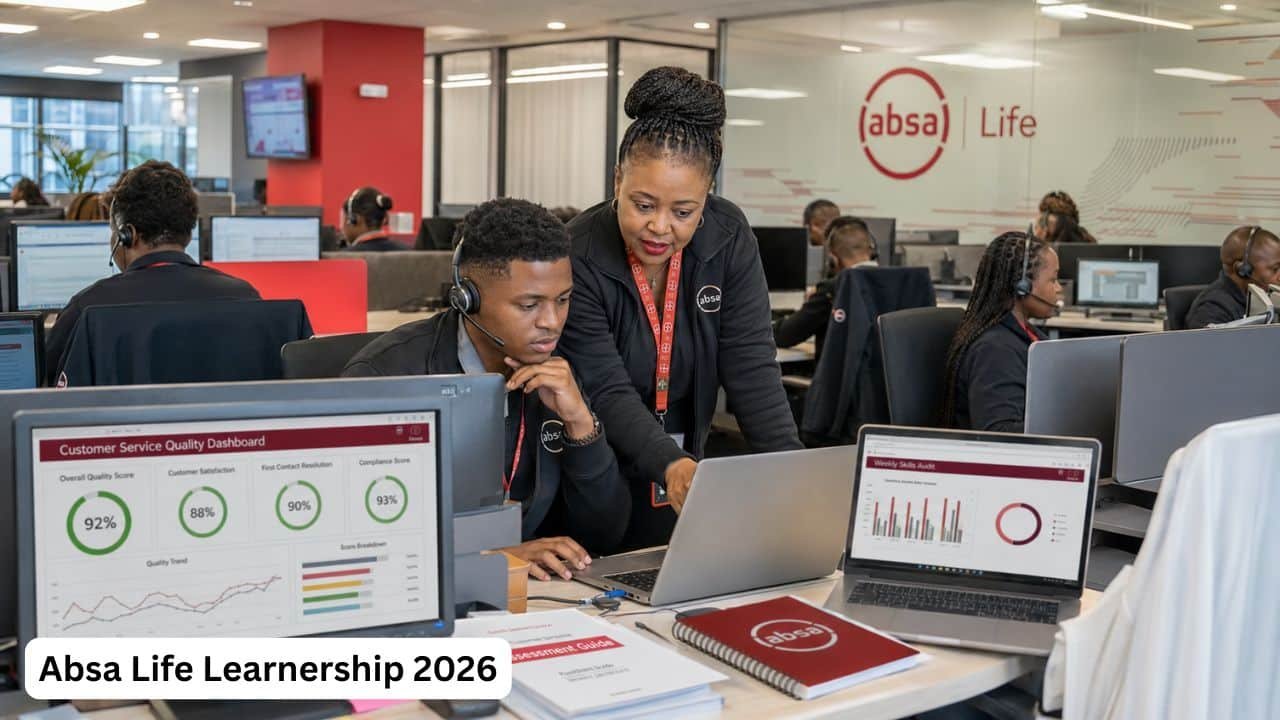
Young South Africans looking to start a career in financial services can now apply for the Absa Life Unemployed Learner Programme 2026.
This fully funded initiative is designed to help unemployed youth develop practical skills while gaining experience in a professional banking environment. Successful applicants will receive structured workplace training and exposure to one of South Africa’s largest financial institutions.
Applications close on 25 July 2026, and eligible candidates are encouraged to submit their profiles before the deadline.
To be considered for this intake, you must meet the following baseline criteria:
Education: You must hold a valid Further Education and Training Certificate (FETC) in Education, Training and Development (ETD), or a closely related equivalent qualification.
Employment Status: You must be currently unemployed.
Location: You must be able to work at the campus in Johannesburg daily.
Employment Equity: In line with the Employment Equity Act, preference will be given to suitable candidates from designated groups (Black, Coloured, Indian, and persons with disabilities) to support diversity.
Please Note: A standard Grade 12 (Matric) certificate alone does not meet the educational requirement for this specific vacancy. You must have the required ETD certificate to pass the initial screening.
What You Will Do (Key Duties)
As an unemployed learner at Absa Life, you will be trained to assist with learning and development services. Your daily tasks will include:
Administration: Interacting with inbound or outbound consultants to help support daily customer service quality targets.
Skills Audits: Participating in weekly skills audit tests to continuously improve your banking and industry knowledge.
Customer Support: Learning how to handle and resolve customer requests effectively on the first contact.
Performance Tracking: Working with your assigned team to meet productivity goals and schedule requirements.
Coaching: Participating in regular performance assessments and coaching sessions to build your skills.
Before starting your application, ensure you have clear, scanned copies of the following documents ready (preferably combined into a single PDF file under 5MB):
An updated, professional CV.
A certified copy of your ID (Smart Card or green barcoded book).
A certified copy of your Matric certificate.
A certified copy of your FETC in Education, Training and Development.
Your proof of residence.
Note: Document certifications should ideally be less than 3 months old.
How to Apply: Step-by-Step
Follow these steps to submit your application directly to the official database:
Go to the Portal: Visit the official Absa Careers website. Avoid using third-party job boards to ensure your application goes directly into the bank’s system.
Search the Job ID: Use the search bar on the careers page and type in the unique job requisition ID: R-15989088.
Open the Ad: Click on the title “Unemployed Learner – Absa Life” to open the official job advertisement.
Click Apply: Click the “Apply” button to open the application portal.
Fill in the Forms: Complete the digital application questionnaire manually and accurately. Make sure your contact information and educational background match your certificates exactly.
Upload Documents: Attach your CV and certified documents when prompted by the system.
Submit: Review your information one last time and submit before the closing date on 25 July 2026.
Practical Tips for Your Application
Apply Early: Do not wait until the final day. High traffic can slow down corporate recruitment platforms, and some systems close early if a maximum number of entries is reached.
Match the Keywords: While you should not stuff keywords, ensuring terms like “customer service,” “administration,” and “skills audit” appear naturally in your CV can help you clear the system’s basic filters.
Use a Professional Email: Ensure your application is linked to an email address you check daily (e.g., yourname@email.com), as all invitations to assessments or interviews will be sent there.
What does the “Unemployed Learner” designation mean legally?
It means you enter into a fixed-term training contract. Absa provides you with a monthly financial allowance (stipend) and practical workspace training for a set period. It does not automatically guarantee a permanent job once the training ends.
Where exactly is the workplace located?
The role is based at Absa’s corporate offices in Johannesburg, Gauteng. Successful candidates must be able to travel to this location daily to fulfill their practical hours.
Does Absa offer a stipend for this role?
Yes. Funded learnerships in South Africa are legally required to provide a monthly learner allowance (stipend) to help cover basic expenses like transport and meals. The exact amount will be confirmed in the formal contract if you are selected.
Can I apply if I don’t have the ETD certificate?
Training and Development as a required qualification. If you do not have it, the platform’s automated filters will likely reject your application.
Are there any application fees?
No. Legally, a real corporate learnership will never ask you to pay an application fee, administrative fee, or training fee. If anyone asks you for money to secure a spot, it is a scam.
Nonhlanhla Ndlovu
Nonhlanhla Ndlovu is the Founder and Editor-in-Chief of Seta.EduFeeds, an independent South African publication dedicated to helping students, graduates, and job seekers discover verified learnerships, internships, bursaries, graduate programmes, apprenticeships, and entry-level career opportunities.
With a strong focus on South Africa’s skills development and employment landscape, she researches and publishes practical, easy-to-understand articles that help readers navigate application requirements, recruitment processes, and career pathways. Her editorial work aims to make complex information accessible, especially for first-time applicants entering the job market.
Before an article is published, Nonhlanhla verifies information using official employer, government, SETA, university, and institutional sources whenever possible. She believes that opportunity journalism should do more than report vacancies—it should explain what opportunities mean, who qualifies, how to apply correctly, and how applicants can avoid common mistakes.
Under her editorial leadership, EduFeeds has become a trusted resource for thousands of South Africans looking for reliable information on education, training, and employment opportunities. The publication follows clear editorial standards that prioritise accuracy, transparency, regular content updates, and people-first reporting.
Beyond publishing opportunities, Nonhlanhla is passionate about empowering young South Africans with the knowledge needed to make informed career decisions. She believes that access to clear, trustworthy information can help reduce barriers to employment and improve access to life-changing opportunities.
When she is not researching new programmes or reviewing articles, she focuses on improving EduFeeds’ editorial quality, ensuring readers receive timely, accurate, and practical information that supports their education and career journeys.